Freemium vs Free Trial for SaaS:
A Full Funnel View
85% of high-growth SaaS companies offer a free plan — yet typical conversion data favors free trials. New benchmarks and a full funnel analysis explain why.
High-growth SaaS overwhelmingly chooses freemium
Here's a striking pattern: 86% of the fastest-growing B2B subscription SaaS companies offer an always-free plan. Among SaaS companies overall, that figure is just 20–30%. That's not a marginal difference. The highest-growth companies adopt freemium at 3–4x the rate of the broader market.
The conversion data story
In early 2026, ChartMogul, Growth Unhinged, and ProductLed surveyed 200 software products to benchmark free-to-paid conversion across models. The results, per 1,000 website visitors:
| Freemium (median) | CC-required trial (median) | |
|---|---|---|
| Landing page visitors | 1,000 | 1,000 |
| LP → sign-up rate | 8–10% | 3–4% |
| Free users / trialists | 80–100 | 30–40 |
| Free → paid conversion | 3–5% | 25–35% |
| Net paid customers | 3–5 | 8–14 |
On a per-visitor basis, CC-required trials produce more than double the paying customers. So if CC-gated trials produce more paying customers, why do the fastest-growing SaaS companies overwhelmingly choose freemium?
Two factors resolve the paradox
Factor 1: A free product drives more landing page visitors
The funnel data above holds one critical variable constant: both models start with 1,000 landing page visitors. In practice, that assumption doesn't hold. A free plan turns your product into a distribution channel — free users share links, invite teammates, create public content, and refer others, generating visitors you didn't pay for. That product-generated traffic loop doesn't exist without a free plan.
There's limited causal data quantifying the exact multiplier. But the directional evidence is compelling: Slack grew to over 100 million users with 95% direct traffic and no traditional sales team. Notion achieves 95% organic traffic through community-created templates and public pages. Dropbox went from 100,000 to 4 million users in 15 months, driven by its file-sharing loop. These represent three different viral mechanisms — workspace invites, content/SEO, and referral incentives — but all share the same underlying dynamic: each free user creates the conditions for the next one to arrive.
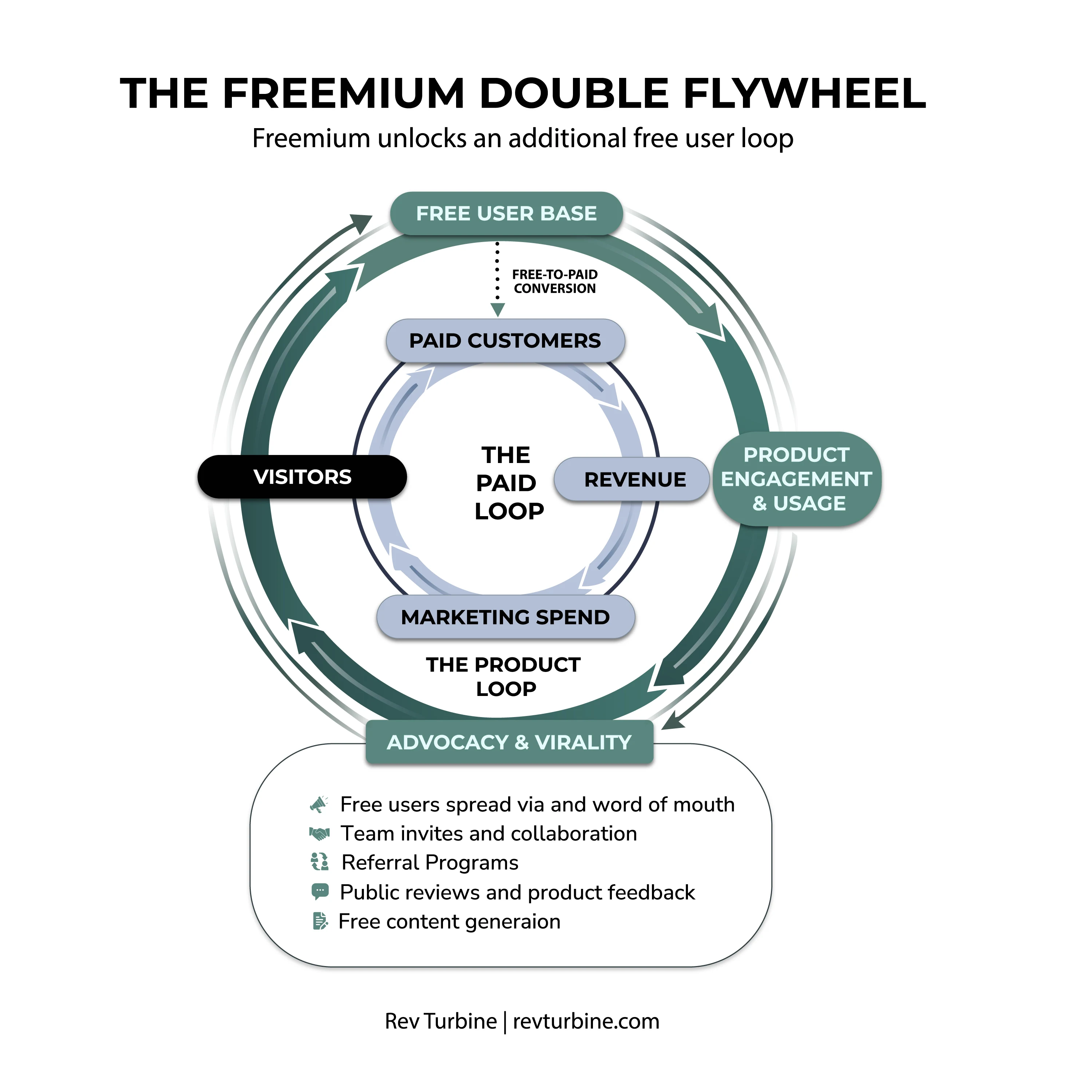
Over time, this compounds into something larger. Products like Zoom, Canva, and Notion now generate the majority of their traffic organically — because "free" made them default tools in their categories. That kind of brand presence is not available to trial-only products at any marketing budget.
Factor 2: High-growth companies invest in systematic monetization
The median freemium conversion rate is 3–5%. The top quartile is 8–12%. That 2–3x gap separates companies where freemium is an expensive free-rider problem from those where it's a growth engine.
The companies in the 85% don't accept median conversion. They treat plans, pricing, and the in-app experience as a product surface under continuous optimization:
- Systematic iteration on the full monetization stack. Plans, entitlements, messaging, offers, timing, and targeting — all treated as testable, optimizable surfaces rather than a set-and-forget decision.
- Sophisticated gating design. Among the fastest growers, usage-based limits are near-universal, and 74% gate on three or more different metrics. PostHog, Linear, and Supabase all use per-period resets and collaboration features that naturally expand as teams grow. Runway gives free users video generation but with a weaker model and watermarks; ElevenLabs limits characters and processing speed. Users taste premium value, stay engaged, and upgrade contextually — rather than hitting a hard wall.
- Contextual upsell triggers. Paywalls and upgrade prompts that appear at the moment of value — when a user hits a limit or tries a gated feature — not on a pricing page they have to navigate to.
- Continuous experimentation. Fyxer AI grew from $1M to $30M ARR running ~500 experiments in a single year. One change — defaulting to a higher-priced annual plan — lifted month-zero revenue by 67%.
This is not a one-time pricing decision. It's an ongoing discipline.
When both factors combine
What happens when a freemium product drives more visitors AND converts at top-quartile rates? The following is illustrative, using 75th percentile conversion benchmarks and an assumed traffic multiplier to explain the freemium upside:
| Freemium | CC-required trial | |
|---|---|---|
| Landing page visitors | 2,000–4,000 | 1,000 |
| LP → sign-up rate | 8–10% | 3–4% |
| Free users / trialists | 160–400 | 30–40 |
| Free → paid conversion (75th pctl) | 8–12% | 50–60% |
| Net paid customers | 13–48 | 15–24 |
The traffic multiplier is an assumption — but the conversion benchmarks are from the research, and the math illustrates why high-growth companies disproportionately choose freemium despite worse per-visitor conversion. When the distribution loop works, the upside ceiling is substantially higher.
Freemium isn't always the answer
None of this means freemium is universally superior. Freemium struggles when the marginal cost of each free user is high (noting even for AI-heavy infrastructure, free-user costs can often be managed with the right usage gating strategy), when the product requires significant onboarding to reach value, when non-serious users overwhelm the free tier without converting, or when there is no natural sharing or collaboration loop to drive distribution. In those cases, a CC-gated trial can be a better filter — qualifying serious buyers before you incur cost.
The simple decision rule: freemium wins when distribution loops are strong, marginal free-user cost is low, and activation is fast. Trials win when costs are high, value realization is slow, or buyers are centrally controlled.
The details vary by business:
| Factor | More suited to freemium | More suited to trial / CC-gated |
|---|---|---|
| Marginal cost per free user | Low — pure software (Notion, Figma, Linear) | High — AI compute, data infrastructure |
| Viral / network potential | Strong — sharing, collaboration, public output (Slack, Loom, Canva) | Limited — single-user, back-office tools |
| Time to "aha moment" | Fast — users self-serve to value in minutes (Trello, Canva, ChatGPT) | Slow — requires guided onboarding, configuration (ERP, complex analytics, security tools) |
| Buyer type | Individual / team — bottom-up adoption | Enterprise procurement — top-down |
| Competitive landscape | Crowded — free removes the biggest barrier to trying your product | Differentiated — trial qualifies serious buyers |
| Regulatory / trust requirements | Low | High — buyers expect qualification gates (fintech, healthcare, legal tech) |
Many of the smartest companies use hybrid approaches: freemium for broad adoption, with a CC-gated trial or sales motion layered on for enterprise segments.
The model opens the door. The execution captures the value.
The 85% stat tells you what the fastest growers have figured out. If your product has the conditions for the top-of-funnel flywheel, freemium has greater upside than any trial model. But the model choice alone doesn't deliver that upside — it requires continuous optimization of entitlements, gating, in-app offers, targeting, and experimentation to close the gap between 3–5% and 8–12% conversion.
The operational challenge is that this requires dedicated infrastructure. Most SaaS teams either build it from scratch — competing with core product development for engineering time — or don't do it at all.
RevTurbine provides that infrastructure: the monetization layer that lets SaaS teams optimize free-to-paid conversion without engineering overhead, so product teams can focus on building the product that drives the flywheel. We are offering a free monetization audit during our beta — book a session and we'll benchmark your funnel against the patterns we see across hundreds of SaaS businesses.
Sources: RevTurbine analysis of 60 fastest-growing SaaS companies · ChartMogul / Growth Unhinged / ProductLed free-to-paid conversion report (2026) · Growth Unhinged: Fyxer AI growth profile
See also: Product-Led Growth 101 · The Monetization Tech Stack · How to Add Freemium Without Cannibalizing Conversion
Get more insights like this
Join SaaS founders and growth leaders getting actionable monetization insights.
Book a free diagnostic: Benchmarks, funnel analysis, pricing review, opportunities
During the beta, we're offering complimentary monetization audits and PLG advisory sessions.