How to add a freemium loop
without cannibalizing paid conversion
High-growth SaaS businesses have worked out how to capture the volume upside of freemium while limiting cannibalization of paid conversion.
Leading SaaS products with an always-free ("freemium") plan achieve disproportionately fast growth via a large free user base, that is used to grow further: 86% of the fastest-growing B2B subscription SaaS companies offer a freemium plan. But benchmark data shows a harsh tradeoff: a typical freemium product converts 3–5% of signups to paid, versus 25–35% for credit-card-gated trials. Simply adding a free plan to gain volume will cannibalize otherwise high-converting paid sign-ups. As a result, most smaller SaaS businesses, without large growth teams, shy away from it.
An increasing number of high-growth SaaS businesses capture the volume upside of freemium while limiting cannibalization of paid conversion.
How? By separating the free experience from the paid offer.
The separation spectrum
There is a spectrum of how separated the free proposition is from the paid offer. The separation is commercial — how differently free is positioned and marketed relative to paid — and product-level — how different the free product is from what paying customers get.
We have identified four models.
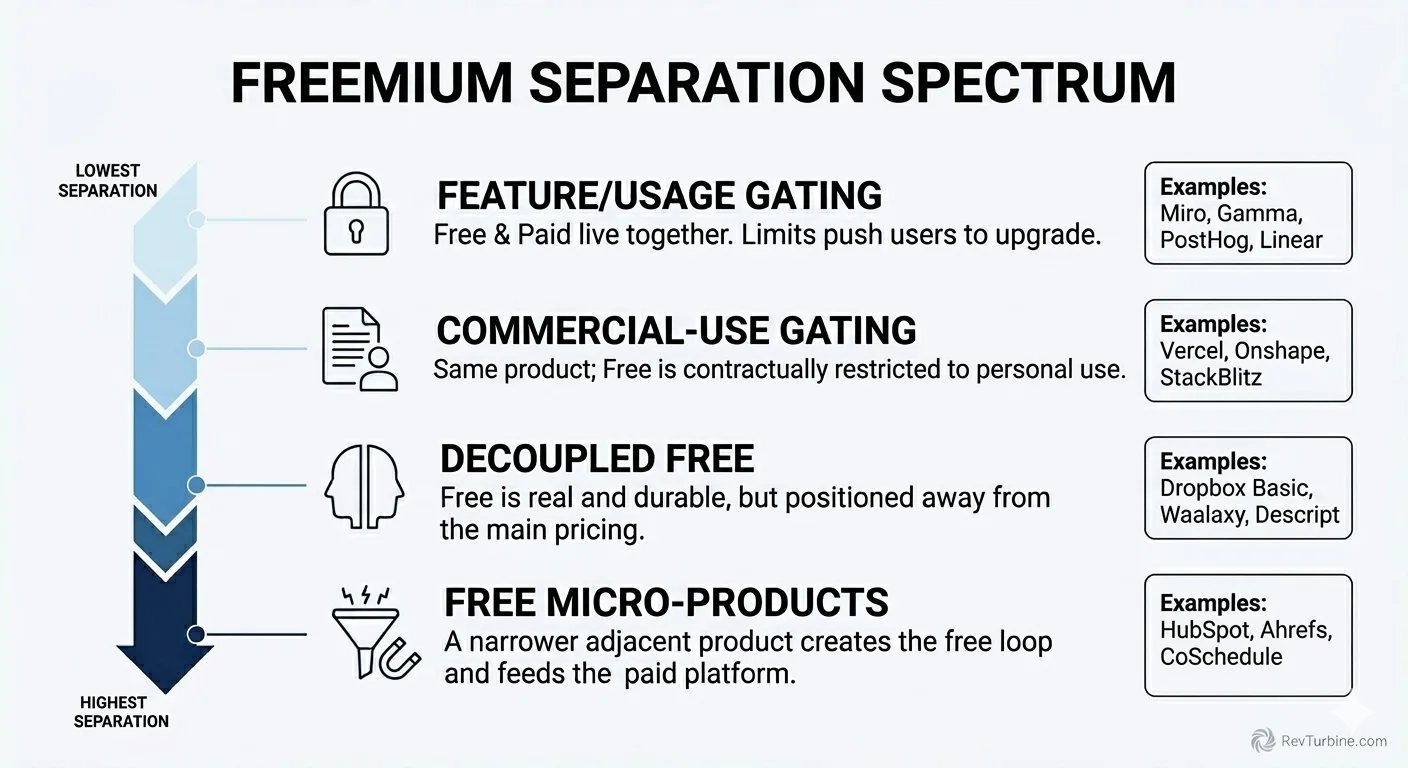
In general, the more separated the free motion is from the paid buying path, the lower the cannibalization risk — but usually the weaker the direct exposure of free users to the core paid product.
The right model depends on your product, your viral mechanics, and how nervous your business is about cannibalization. Here is how each one works.
1. Feature/usage gating
The most common model: an always-free plan right on the pricing page with feature and usage limits that segment users by willingness-to-pay (good old implicit pricing segmentation). It scales well, but the tradeoff is difficult: too generous and you cannibalize paid conversion; too stingy and you lose the volume that makes freemium worthwhile. The companies that make it work invest heavily in gating experimentation.
Miro is a strong example. Its Free plan includes one workspace with 3 editable boards and allows unlimited team members — keeping the collaboration loop open, which is the whole point. But Miro reserves the deeper production workflow for paid: after three boards, older boards become view-only, and the free plan does not allow private boards. Miro now serves more than 100 million users in 250,000 organizations using this motion. Among other high-growth SaaS companies, PostHog and Linear follow the same playbook — generous free tiers (1 million events per month at PostHog; unlimited users at Linear) with multiple independent usage limits that each create their own upgrade trigger as teams grow.
Gamma uses a different gating mechanic. New users receive 400 one-time AI credits — enough to create roughly 10 presentations. Credits do not renew. Once exhausted, the free plan becomes a viewer, not a creator. Users can earn additional credits via referrals, turning free users into a distribution channel. Paid plans (Plus at $8/month, Pro at $18/month) unlock unlimited AI generation and remove the "Made with Gamma" badge from exports.
2. Commercial-use gating
In some cases, it’s possible to restrict the free plan explicitly, and contractually, to specific uses.
Vercel is one of the best modern examples. Its Hobby tier is for personal, non-commercial use, while Pro is for professional developers, freelancers, and businesses. Its fair use guidelines go further: all commercial usage requires Pro or Enterprise. The product stays fully functional on free, but the paid boundary is legible and defensible. Vercel has grown rapidly to well over $200 million ARR, double-dipping via free and paid growth loops.
Onshape uses the same pattern. Its Free plan is for hobbyists and learners, is non-commercial only, and requires public document storage. Paid is for professionals who need private storage and commercial workflows. StackBlitz is similar: its free Personal tier is limited to public projects, while paid plans unlock private repos and team collaboration — a natural boundary between exploration and professional use.
The point of this model: keep free useful, but define it as a different class of use than the one your business monetizes.
3. Decoupled free
In this model, the free plan is real and durable — but it does not sit alongside paid plans on the main pricing page. It lives elsewhere: on its own landing page, in a separate signup flow, below the fold, or as the quiet fallback after a downgrade. The separation is commercial rather than product-level — the free experience may use the same core product, but it is deliberately positioned away from the paid purchase decision.
Dropbox Basic is the clearest example. It has its own dedicated landing page, offers 2 GB of storage, and remains a real free account with sharing and sync. But Dropbox’s main plans page leads with paid plans and trials — Basic is not part of that comparison. The free motion is real and separately branded, but not the headline commercial path.
Waalaxy and Descript both show variants of this pattern, where free remains the default entry path but is less prominent at the point where users compare paid plans. Waalaxy’s pricing page shows only paid plans; Descript leads with paid above the fold and places free in a separate card below. Both use free signup as the main landing page CTA — minimizing friction for new users while keeping the pricing page focused on paid conversion.
4. Free tools (micro-products)
The most separated model is not freemium on the core product at all. It is a micro-product or adjacent wedge that creates the free loop and feeds the main platform.
HubSpot Website Grader is the classic example. HubSpot calls it its original free marketing tool, and it eventually graded over 2 million website URLs. CoSchedule’s Headline Analyzer follows the same playbook: a free tool that scores blog headlines, feeding the paid marketing calendar platform. Both required building a distinct product from scratch.
But there is a lower-cost version of this pattern. Ahrefs Webmaster Tools is not a separate product — it is the same Site Audit engine as paid Ahrefs, scoped to your own verified sites with a 5,000-page crawl limit. Ahrefs carved out a slice of its existing product, gave it standalone branding and its own landing page, and packaged it as a free tool. No new product engineering — just a tightly defined entitlement boundary and a marketing wrapper.
This second approach is worth noting because it is increasingly accessible — see ‘Where RevTurbine fits’, below.
How to choose
The right model depends primarily on how much cannibalization risk you can tolerate and the feasibility of each option for your business.
Use feature/usage gating if your product has strong viral loops, low marginal cost per user, and feature depth or usage/credit/seat limiting allowing clear feature differentiation between plans. This is the highest-distribution model. It works best when the product naturally creates upgrade triggers — collaboration limits, usage caps, feature gates — that push professional users toward paid without artificially crippling the free experience.
Commercial-use gating is a great solution if your product serves both personal and professional use cases. The personal/commercial boundary is legible, defensible, and does not require stripping features. It works especially well for developer tools and creative platforms where hobbyist use is genuine.
Consider decoupled free if you have the marketing capacity and want the volume benefits of free without competing against your own paid plans on the pricing page. This is less commonly used but appears to have strong potential.
Use free tools when the core product cannot support a free tier without significant cannibalization risk, but you still need a top-of-funnel growth loop. This works well when you can identify a narrower job-to-be-done that your target audience has — one that a lightweight free tool can solve while demonstrating the value of your broader platform.
Many companies layer models over time. HubSpot used free tools as wedges long before offering a free CRM tier.
Where RevTurbine fits
Choosing a model from this spectrum is the strategic decision. But execution constraints can derail it.
High-performing SaaS businesses continuously test limits, gating styles, upgrade timing, and offer variants — creating a feedback loop between entitlements, nudges, and measured revenue outcomes. Every free-to-paid boundary requires entitlement configuration: what is gated, what is soft-gated, what is open. Every gating decision needs upgrade triggers: when does a free user see an upsell, and what does it say? Every experiment — adjusting a usage limit, testing a different upgrade prompt, changing what happens on downgrade — requires code changes, deployment, and instrumentation.
RevTurbine uses data to help SaaS teams make the right design decisions, operationalize boundaries (entitlements, upgrade triggers, downgrade paths), and experiment without hard-coding each iteration — shipping in days instead of sprints.
If you are building or rethinking your freemium motion, book a call.
See also: Freemium vs Free Trial: A Full Funnel View · The 60 Fastest-Growing SaaS Companies · The Monetization Tech Stack
Get more insights like this
Join SaaS founders and growth leaders getting actionable monetization insights.
Book a free diagnostic: Benchmarks, funnel analysis, pricing review, opportunities
During the beta, we're offering complimentary monetization audits and PLG advisory sessions.