The 60 Fastest-Growing SaaS Companies: 10 Lessons
What the highest-growth software companies reveal about modern plans, pricing, and monetization — and why static pricing is holding you back.
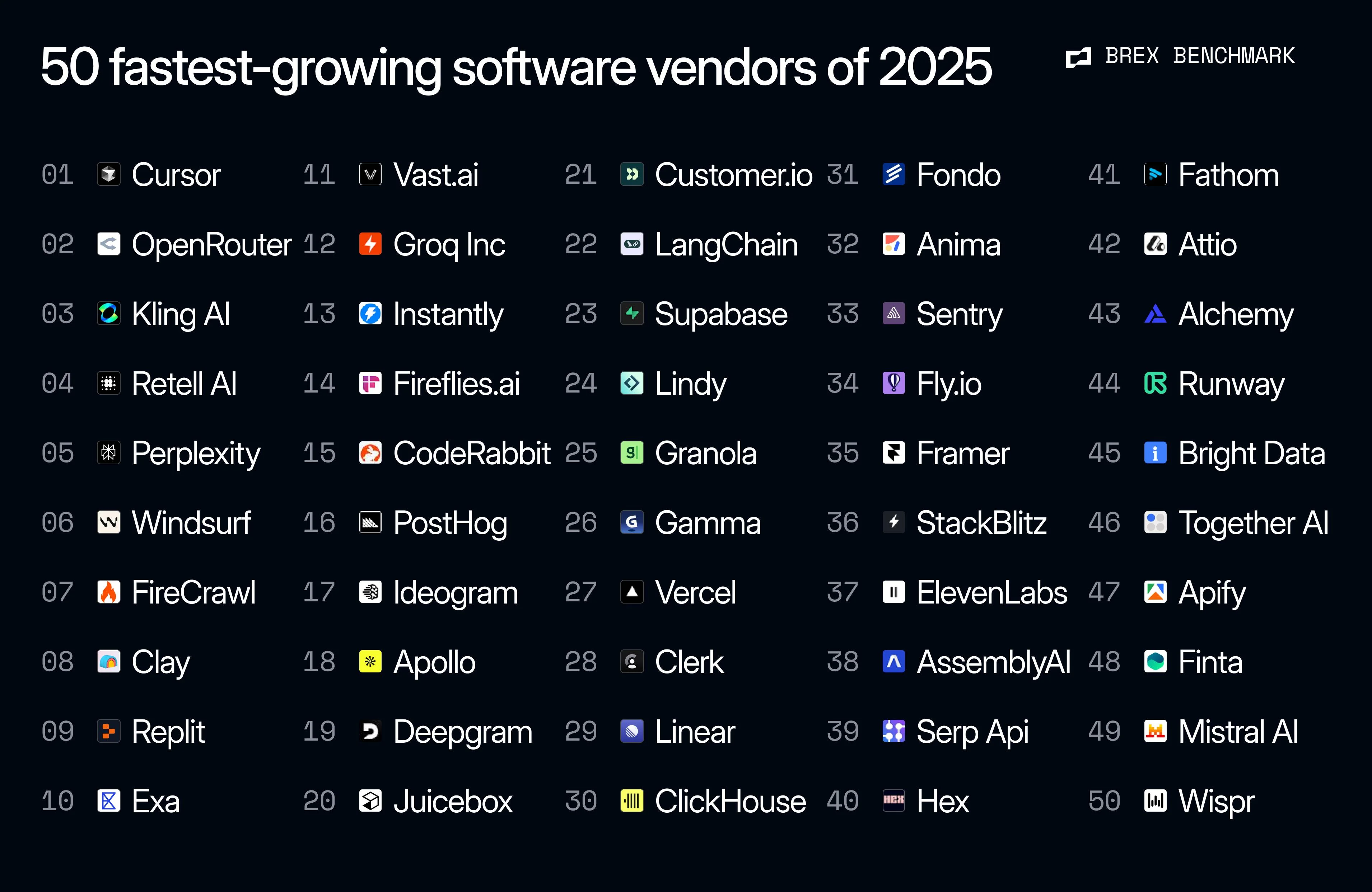
Pure subscription pricing is nearly extinct among the fastest-growing software companies. Across the 60 fastest growers of 2025–26 — Brex's December 2025 ranking plus the net-new names from its Spring 2026 update — only 12% price on subscription alone. The rest pair a recurring base with usage, credits, and metered entitlements.
We examined the public pricing pages, plans, and entitlement models of all 60. The findings challenge conventional wisdom, and they help explain the >5X gap in conversion and growth between top- and bottom-quartile SaaS businesses.
1. AI SaaS leaders 'subscriptionify'
The subscription hasn't gone away — it has absorbed usage. About 70% of the fastest growers keep a subscription base, but pure subscription is now rare (12%); hybrid models that pair a recurring plan with usage, credits, or overage dominate at 58%.
AI-native businesses like ElevenLabs, Runway, and Gamma "subscriptionify" inherently variable costs — credit bundles, overage charges, and hybrid structures that give customers the predictability of a subscription while letting revenue scale with usage. The model isn't disappearing; it's getting more sophisticated.
Consumer AI runs the same play, harder: 84% of the top consumer AI apps charge a subscription or hybrid, and many wrap usage in earnable virtual currencies — Character.AI's Charms, PolyBuzz's Coins, CivitAI's Buzz — that users earn through engagement or buy to unlock more.
2. Freemium is the norm, not the exception
One of the most striking findings: 86% of the high-growth subscription and hybrid companies offer an always-free plan, compared to 20–30% of SaaS overall.
Freemium doesn't guarantee growth, but sustained hyper-growth in B2B SaaS rarely happens without it. A free plan removes the biggest barrier to adoption — the credit card. With no payment gate at sign-up, trial friction drops to near zero, and that drives organic virality. Free users share links, invite teammates, create public content, and embed your product in their workflows. Each becomes a distribution channel.
The best free plans aren't charity. They're designed to build habitual use, deliver repeated "aha moments," and create frequent, natural upgrade moments. PostHog, Linear, Supabase, and Framer all use generous free tiers to drive adoption, then gate on usage and collaboration features that expand with team size.
Consumer AI takes freemium further still: 93% of the top consumer apps offer an always-free plan. To fund it, free tiers are increasingly ad-supported — ChatGPT, Character.AI, and Meta AI all introduced ads in 2026 — a reminder that "free" still has to be paid for somehow.
3. Four plans is the new standard
The old "Good / Better / Best" three-tier model is giving way to four. Among the companies we studied, the median number of plans is four, and 74% have four or more.
The typical structure: a free tier, two mid-range paid tiers differentiated by usage and features, and an enterprise plan with "contact us" pricing. That enterprise tier matters even without dedicated enterprise features — it signals positioning, enables a sales-led motion, and provides pricing flexibility.
Supabase follows it exactly — Free → Pro → Team → Enterprise — and Linear and Notion run the same four-rung shape: a free tier, two paid tiers, and an enterprise plan. Each rung adds usage headroom and collaboration capabilities, creating natural upgrade pressure as teams grow. Companies pushing past five plans tend to be those where value scales continuously — credits, tokens, compute minutes — and users self-segment by spend, like ElevenLabs with its character-based pricing.
4. The pricing page is a marketing abstraction
The public pricing page is increasingly a simplification of what's happening underneath. The "hero table" visitors see intentionally masks far richer entitlement structures.
Think of it in three layers:
- The hero table — a clean marketing abstraction. One or two usage limits, key feature differentiators, understandable in 30 seconds.
- Additional detail — other usage metrics and features that differentiate plans and drive upsell, often in expandable sections or comparison pages.
- Not publicly stated — niche features, fair-use limits, and experimental gates that provide flexibility to test without committing publicly.
Vercel's page shows a clean Hobby / Pro / Enterprise comparison. Underneath sit dozens of granular limits on build minutes, bandwidth, edge function executions, and serverless duration — each an independent upgrade trigger. The layered approach lets companies iterate on entitlements without re-architecting their public offer, and test pricing changes with specific segments before broad rollout.
5. Pure seat-based pricing is almost extinct
Among the fastest growers, every instance of seat-based pricing was part of a hybrid structure. No company relied on seats alone.
Seats are easy to understand but poor at capturing the value most software now delivers. As products become more workflow- and AI-driven, value scales with usage, not headcount. Usage-based components are now near-universal among subscription and hybrid plans, and 74% gate on three or more different metrics. A third combine usage gates with seat-based pricing.
Linear gates on seats but also limits issue history depth and advanced features by tier. Fireflies.ai combines seat pricing with transcription-minute limits and storage caps. The seat is rarely the only lever.
6. Soft gating is replacing hard feature paywalls
Traditional feature gating was binary: you had access or you didn't. The fastest growers have moved to soft gating — lower-tier users get a degraded version of a premium feature rather than being locked out.
Runway gives free-tier users video generation, but with a weaker model and watermarked exports. ElevenLabs lets free users generate voice content, but with fewer characters, slower processing, and no premium voices. Ideogram offers image generation on free plans, but with reduced queue priority and limited styles.
Soft gating lets users experience premium value, builds habit formation, and creates contextual upsell moments — without the hard stop that frustrates users and damages brand perception.
7. Usage limits are being "created" from features
Companies aren't just gating existing usage metrics — they're engineering new ones by decomposing features into measurable, limitable units.
"AI meeting notes" becomes "meetings transcribed per month" (Fireflies.ai). A collaboration feature becomes "active shared workspaces." PostHog decomposes its analytics suite into separately metered dimensions — events ingested, session replays, feature flag evaluations — each with its own limit and upgrade trigger.
The smartest implementations use per-day or per-week resets rather than aggregate caps. Daily resets bring users back, create repeated upsell moments, and avoid the trap where a user hits their cap in week one and has no reason to return for three weeks. Ideogram's daily generation credits are one example — users return every day to use their refreshed allocation.
8. AI tools are bringing back the command line
AI-powered tools have made the CLI an important new surface for monetization. As developers and power users spend more time in terminals and AI coding assistants, companies like Cursor, Windsurf, and Vercel extend their credit-based and subscription monetization directly into the terminal.
When a developer exhausts their AI completions or build minutes from the CLI, the upgrade moment happens right where they're working — not on a pricing page they have to navigate to, and not in a marketing email they'll ignore. The terminal works as a monetization surface because usage, value, and the moment of friction all converge in one context.
9. Throttle, don't cut: degradation is the new hard cap
When users hit a usage limit, the fastest-growing companies don't cut access — they degrade it. Throttling, queue deprioritization, model downgrades, and reduced functionality replace the hard wall, keeping users engaged while creating continuous upgrade pressure.
The patterns are varied:
- Performance throttling — Vercel queues builds behind higher-tier users; Supabase throttles API requests and can pause projects before triggering overage billing. These are runtime behavior changes users feel immediately, not billing events.
- Quality degradation — Runway reverts free-tier users to a weaker model and watermarks exports; ElevenLabs removes premium voices and slows processing. The product still works, just not as well.
- History and retention gating — PostHog reduces retention windows and pauses session recording after caps; Sentry stops recording errors once the monthly limit is hit; Fireflies.ai makes older transcripts inaccessible. The value erodes over time, not just at the moment of the limit.
- Soft-to-hard progression — Framer escalates gradually: warning → publishing disabled → domain locked → CMS blocked.
Consumers are especially intolerant of surprise bills. Among the top consumer AI apps, automatic per-unit overage is almost extinct (~8%) — when a user hits a limit, they're asked to top up or upgrade, not handed an unexpected charge. The lesson travels back to B2B: hard caps create one frustration event; degradation creates a continuous, lived experience of the gap between free and paid. Make the limit a prompt, not a penalty.
10. The fastest growers iterate constantly
The most important pattern: hyper-scaling companies evolve their plans, entitlements, and lifecycle flows at an accelerating pace. They treat pricing as a product surface, not a one-time decision.
This is where the gap between fast and slow growers compounds. Companies that can test a new usage limit, change a gate, or launch a targeted upsell experiment quickly run dozens more experiments per year — and each one compounds into better conversion, expansion, and retention.
Fyxer AI grew from $1M to $30M ARR in 2025, supported by a growth team that ran 514 experiments — more than two per working day, with a four-person growth squad shipping 360 of them. One winning experiment — defaulting to a higher-priced plan with annual billing communicated monthly — lifted month-0 revenue by 67%. That's not a pricing decision; it's a velocity advantage.
Modern plans and pricing are a system to experiment with and layer new features onto as you release them — not a decision to make once and revisit quarterly.
What this means for your business
Design for growth from day one. Don't hard-code your monetization logic. Build or adopt a system that lets you adjust entitlements, test gates, and run upsell experiments as fast as you ship product.
Gate more, but gate smarter. Soft gating, usage-based limits, degradation, and per-period resets outperform binary feature walls. Create upgrade triggers that feel helpful, not hostile — and never hand a self-serve user a surprise bill.
Treat pricing as a product. The companies that iterate fastest on monetization grow fastest. If changing a usage limit requires a code deploy, you're moving too slowly.
This is why we built RevTurbine — to give product-led teams the infrastructure to run these patterns without standing up a growth-engineering org. Adjust entitlements and usage limits, run gating and paywall experiments, orchestrate upgrade prompts at the moment of value, and handle downgrades and cancel-saves — all without a code deploy. The companies in this analysis throw growth PMs and engineers at the problem; RevTurbine makes the same playbook accessible without that overhead. If you want to improve your free-to-paid conversion, book a free monetization audit and we'll benchmark your funnel against the patterns we see across hundreds of SaaS businesses.
See also: Freemium vs Free Trial: A Full Funnel View · How to Add Freemium Without Cannibalizing Conversion · Product-Led Growth 101
RevTurbine is the monetization engine for product-led SaaS — helping founders and growth teams convert, expand, and retain customers without complex code changes. Learn more or join the beta.
Methodology: This analysis covers the 60 fastest-growing B2B software vendors of 2025–26 — Brex's December 2025 ranking (top 50) plus the net-new names from its Spring 2026 update. Brex ranks vendors by growth in real card and bill-pay spend across 35,000+ venture-backed customers, and excludes public companies and any vendor over $30B in valuation or $1B in revenue — so the set is emerging high-growth vendors, not incumbents. We examined each company's public pricing pages, plans, and entitlement models.
As a B2C comparison, we also analyzed the a16z Top 100 Gen AI Consumer Apps (web top 50, March 2026, ranked by SimilarWeb traffic). The consumer set amplifies the same patterns — more subscription and hybrid (84%), more freemium (93%), and almost no automatic overage. Conversion benchmarks are from the Growth Unhinged Free-to-Paid Conversion Report. All analysis reflects publicly observable data through Q1 2026.
Get more insights like this
Join SaaS founders and growth leaders getting actionable monetization insights.
Book a free diagnostic: Benchmarks, funnel analysis, pricing review, opportunities
During the beta, we're offering complimentary monetization audits and PLG advisory sessions.